The Dowry in Comedy
Introduction:
What was the ancient Greco-Roman dowry, and how did it appear in representations of marriages? This module examines the dowry as well as the relationships between husbands and wives as characters in the comedy of Greece and Rome, particularly Menander and Plautus.
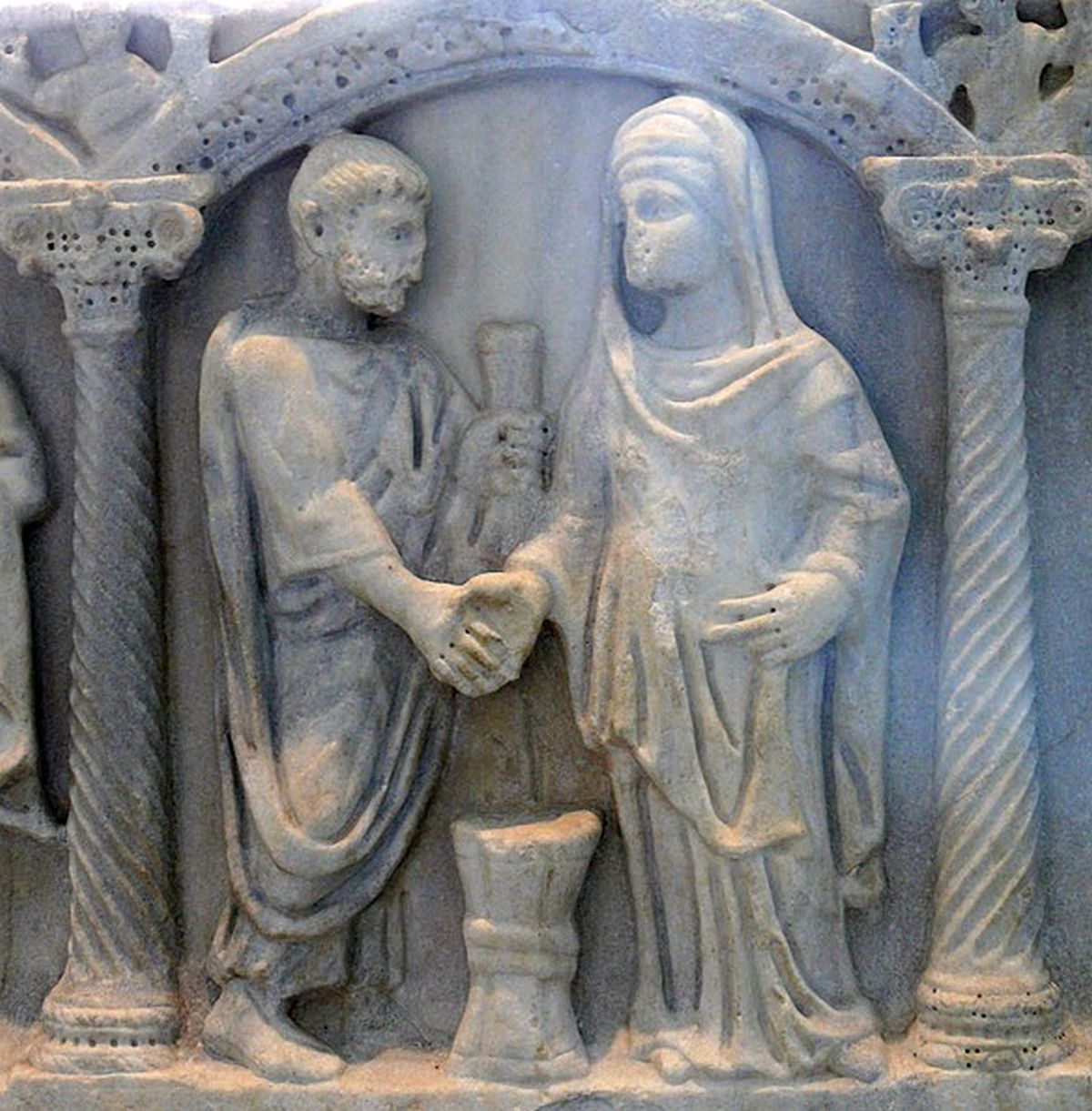
The ancient Greek and Latin words for “dowry” (προικός, dos) mean “gift.” In our modern day, we tend to think of the dowry as a gift of money from the wife’s family to the husband, but in the ancient Greek and Roman world, this doesn’t seem to be the case. In fact, the dowry seems to have consisted primarily of items (textiles, furniture), land, and enslaved people.
A lot of what we understand about ancient dowries comes from comedies, especially those of the playwrights Menander and Plautus. What can we learn about dowries from their plays, and what are the limitations of using literature as evidence for ancient history and culture?
Within the plays of Menander and Plautus, we can see character and plot tropes surrounding dowries. This makes sense, since marriage is a prevalent theme in ancient comedy. One trope in Plautus is the matrona dotata, or “dowried woman.” This character is bossy and independent, and she is able to have power in her marriage because of her large dowry. How much control did women actually have over their dowries, and how is this reflected or distorted in ancient comedy? How might the dowry (its size, its contents, its existence) affect the relationship between a wife and husband?
This module aims to tackle these questions. We can think about these texts in a larger discussion about ancient drama, women in literature, or, alternatively, ancient economies.
Primary Sources:
IMAGES:
- Fragment of the Dioscuri Sarcaphogus (see above)
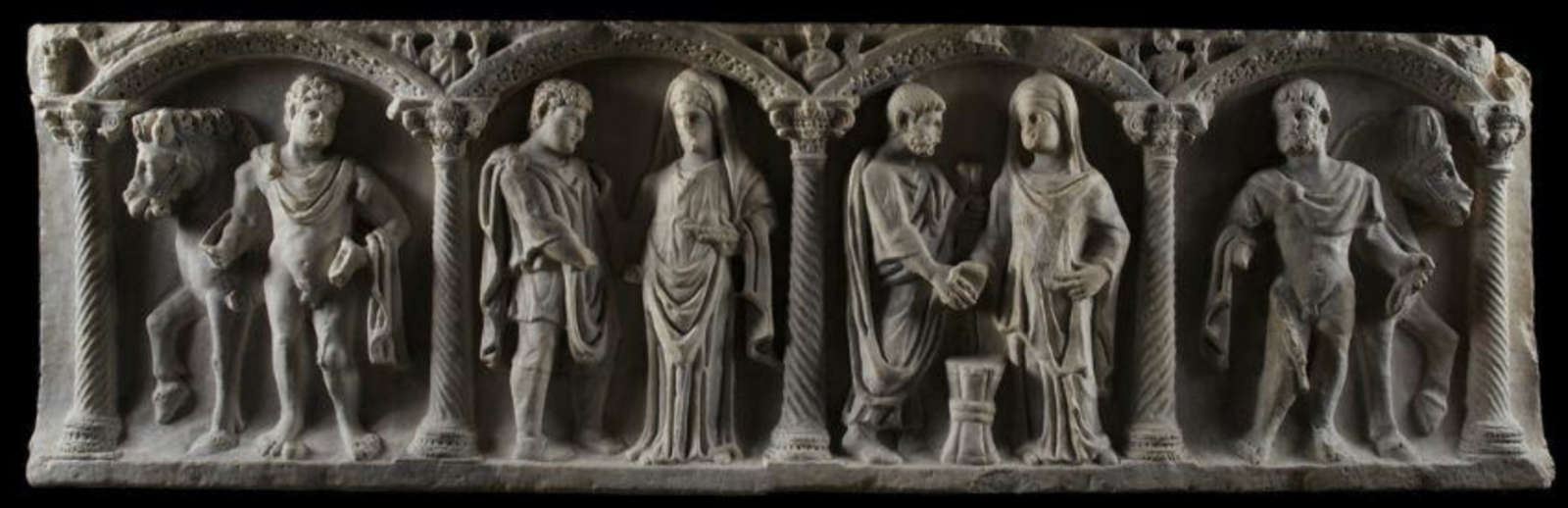
- Full Sarcophagus (see below)
TEXTS:
Here is an open-source pdf of the Greek with facing English prose translation and end notes.
Here is an English translation in verse, by Carroll Moulton (1977), with an introduction and more notes.
If students can read Greek, I suggest reading at least lines 820-840.
For help on the Greek, there is a good Bryn Mawr commentary by David Konstan.
2. Plautus’s Aulularia
Here is an open source English translation by Henry Thomas (1888). It includes translations of other Plautus plays, but the Aulularia starts on page 124. It also has some helpful footnotes.
Here is an open source Latin text.
If students can read Latin, I suggest reading at least lines 505-535.
For help on the Latin, there is a good commentary by Keith Maclennan and Walter Stockert available on JSTOR.
Secondary Sources:
Foxhall, Lin. “Household, Gender and Property in Classical Athens.” The Classical Quarterly 39, no. 1 (1989): 22–44.
Treggiari, Susan. Roman Marriage: Iusti Coniuges From the Time of Cicero to the Time of Ulpian. Oxford: Clarendon Press, 1991. (Introduction, Chapter 4: From Negotiation to Engagement)
Konstan, David. “Aulularia: City-State and Individual” In Roman Comedy, 33-46. Ithaca, NY: Cornell University Press, 1986.
Amy Richlin. “Talking to Slaves in the Plautine Audience.” Classical Antiquity 33, no. 1 (2014): 174–226.
Resources:
MENANDER:
Menander was a comedic playwright, who lived in Athens in the 4th century BCE. His plays were performed at a yearly festival called the Lenaia. The Lenaia was a religious festival in celebration of the god Dionysus and also a theater competition. The Lenaia took place in the winter, when there wasn’t much travel into or out of the city, so the comedies performed at it were written for a specifically Athenian audience. Comedies performed at this festival tended to have themes grappling with inter-familial issues. Menander’s plays won at the Lenaia eight times.
Menander pioneered what we now call “New Comedy,” which is a genre rife with tropes and stock characters. These stock characters include things like the clever slave or the lovesick young man. Later playwrights like Plautus were greatly influenced by Menander. For a long time, we didn’t have any complete plays by Menander. Luckily, archaeologists found the Dyskolos in Egypt in 1952.
DYSKOLOS DISCUSSION QUESTIONS:
What effect does money have on marriage and marriage prospects in Menander’s Dyskolos? Does it affect the men and women in the play the same way, or differently?
Are men in the play (especially Sostratus, Kallipedes, Knemon and Gorgias) depicted as good potential partners? Good family members to their sisters? Cite specific parts of the text.
Lin Foxhall proposes a complicated relationship between a woman, her husband, and the dowry in ancient Athens. What is that relationship as described by Foxhall, and how does it compare to what is presented in the Dyskolos?
PLAUTUS:
Plautus was a Roman comedic playwright who lived in the 3rd to 2nd century BCE. This is at least 100 years later than Menander and in a different cultural/political context. Nevertheless, Plautus was greatly inspired by Menander, and he also wrote what we call “New Comedy.” Unlike Menander, however, we have many full plays written by Plautus.
During Plautus’s time, Rome was a republic. Under the laws of the Roman Republic, fathers (called the paterfamilias) were in charge of their sons’ finances much more than in Menander’s time in Athens. Plautus and Menander’s plays both feature father/son relationships. Plautus’s plays are technically set in Athens, but the sons’ finances are managed by their fathers, as they would be in Rome. This is one way in which Plautus’s plays may have similar characters and themes, but the context is different. Plautus’s plays were also performed at religious festivals, called ludi, though theater was not taken as seriously at the ludi as compared to the Lenaia.
AULULARIA DISCUSSION QUESTIONS:
What is the relationship between the dowry and the potential marriage in Plautus’s Aulularia? Does this align with what Susan Treggiari describes?
Are the male characters (Euclio, Megadorus, and Lyconides) presented as good potential partners/family members? Cite specific lines of the text.
Amy Richlin proposes that people of different statuses (e.g. enslaved people, citizens, and woman) might have different responses to Plautus’s plays. How to you think women might react differently to men?
IMAGE/ DISCUSSION QUESTIONS
This image is part of a sarcophagus, in which a Roman person was buried in the 4th century CE, several hundred years after the plays you’ve read. Here is a link to the museum’s page on it where the sarcophagus is held: https://www.arlesantique.fr/sarcophage-des-dioscures
As the museum’s page says, the scenes on the far left and right sides seem to depict Castor and Pollux, mythological twin sons of Zeus who would accompany mortals to the afterlife. The middle two scenes are a man and woman, possibly a husband and wife. The left could be a wedding, with the right depicting an agreement of a marriage contract.
Look at the “marriage contract” image closely. What might be evidence that this is depicting a marriage contract? What else could it be depicting?
If it is a scene depicting a marriage contract, what might the image be saying about marriage? use specific evidence to answer, such as things you notice about the figures’ clothing, body language, etc.
How does this depiction of marriage compare to what you’ve read in the Dyskolos and Aulularia?
OVERALL DISCUSSION QUESTIONS AND ACTIVITIES
These are both comedies. What is funny about them? Would they be funny to every member of the audience in the same way?
You’ve learned that ancient dowries tended to consist of textiles, jewelry, furniture, land, and enslaved people. Yet, the dowries in these plays only consist of coins. Why do you think that is?
Amy Richlin argues that different audience members may have felt differently about the same jokes in Plautine plays. Choose 1 passage from each play and explore how men and women in the audience might react differently. Do the same with enslaved and free people.
Phaedria never has a spoken line in the Aulularia. Come up with ways she might appear onstage and what she would be doing in particular scenes.
Pitch an idea for how one could adapt this premise for a modern audience set in today’s time. What would the dowry look like?
Draw a diagram of how dowries functioned in the ancient world.